
Hoplite (2nd Printing)
 Podstawowe informacje
| Liczba graczy | 1-4 |
| Zalecany wiek | od 13 lat |
| Czas zabawy | powyżej 180 minut |
| Projektant | Richard H. Berg, Mark Herman |
| Wydanie | angielskie |
| Instrukcja | angielska |
| Złożoność | dla wymagających graczy |
 niedostępny
 dodaj do przechowalni
3.66667
dodaj do przechowalni
3.66667

Opis
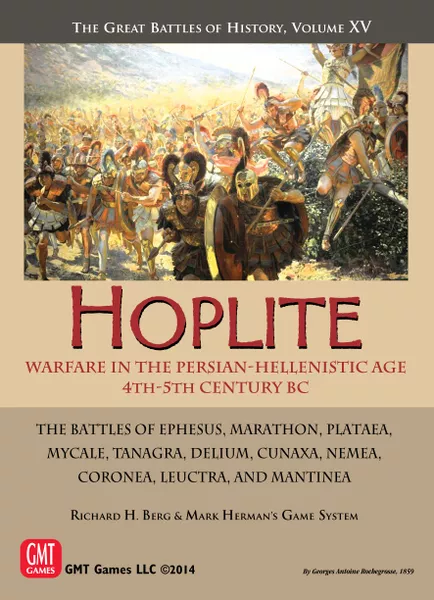
Hoplite, the 15th volume in the Great Battles of History series of games, allows players to recreate classic battles from the pre-Alexandrian Persian-Hellenistic Age, the heyday of the Hoplite (heavy infantry fighting in packed formation). This period is often considered to feature the birth of Western Warfare, as opposed to the Persian/Eastern style, which relied on archery , light cavalry, and mobility.
Exactly how hoplite warfare was fought – what really happened when “the bell rang” – is highly disputed by ancient military historians, even today. Hoplite allows you to test out your theories (well, our theories, using your dice) with eleven of the great battles of this era, from the Battle of Leuctra, featuring the huge 60-man deep phalanx of Beotarch Epaminondas to the classic confrontations with the Persian missile-armed troops against the classic Greek hoplite phalanxes. Hoplite uses detailed mechanics meant to convey all the possibilities of this style of warfare, from The Hellenic Law of Inertia, to Drift to the Right, to the special capabilities of the Persian Light Cavalry (Harassment and Dispersal) to three different levels of Hoplite advance to Combat (the Run Don’t Walk rules) and a whole lot more. We even still have some good old chariots!
And you get to fight what was the biggest land battle in European history up until Napoleonic times, the immense Battle of Plataea (truly the deciding engagement of the Greco-Persian Wars): two maps and about 250 combat counters covering The Greek Contingents from 26 City-States under Pausanias, Spartan Regent and General, vs. The Persians, Medes, Asians (Bactrians, Scythians, Indians and a whole lot of others) and seven Medized Greek city-states, under Mardonius, Persian Commander and son-in-law of The Great King, Darius I.
The package includes Simple GBoH versions for each of the battles along with special rules that highlight the hoplite style of warfare.
| Zawartość pudełka: | Warto zobaczyć: |
|
Wyświetlane są wszystkie opinie (pozytywne i negatywne). Nie weryfikujemy, czy pochodzą one od klientów, którzy kupili dany produkt.
Dawid Tobiasz
Najmniej chyba finezyjna cześć systemu (taki okres i taktyka) ale dobra na krótkie rozgrywki. W czasie jednego posiedzenia można rozegrać kilka bitew w wersji Simple. Część bitew można też rozegrać posiadając SPQR (dodatkowe scenariusze z C3i do znalezienia w sieci).
Marcin
Hoplite (2nd Printing) od GMT Games to znakomita propozycja dla graczy zainteresowanych starożytnymi bitwami i klasycznymi grami wojennymi na poziomie taktycznym. Jako część serii Great Battles of History gra skupia się na epoce hoplitów, falang, greckich polis i konfliktów, w których znaczenie miały szyk, morale, dowodzenie oraz odpowiednie wykorzystanie terenu. Największą zaletą gry jest jej mocny klimat historyczny. Hoplite pozwala poczuć odmienność walk starożytnych: ciężka piechota w zwartym szyku nie działa tu jak nowoczesna armia, lecz wymaga dobrego ustawienia, wyczucia momentu i umiejętnego wykorzystania linii bojowej. Starcia są dynamiczne, ale jednocześnie wymagają planowania, bo błędne rozmieszczenie oddziałów może szybko doprowadzić do załamania całego skrzydła. Na pochwałę zasługuje także bogata zawartość pudełka. Liczne żetony, duże dwustronne mapy, scenariusze i pomoce gracza sprawiają, że gra oferuje dużo materiału do odkrywania. Każda bitwa ma własny charakter, a różnice między armiami i sytuacjami taktycznymi zwiększają regrywalność. Hoplite (2nd Printing) to tytuł wymagający, ale bardzo satysfakcjonujący. Szczególnie spodoba się osobom, które lubią antyk, historię wojskowości i gry wojenne pokazujące, jak ważne były dowodzenie, formacja i morale. To solidna, klimatyczna i elegancko wydana gra, która dobrze pokazuje, dlaczego epoka hoplitów zajmuje tak ważne miejsce w historii sztuki wojennej.