

 Podstawowe informacje

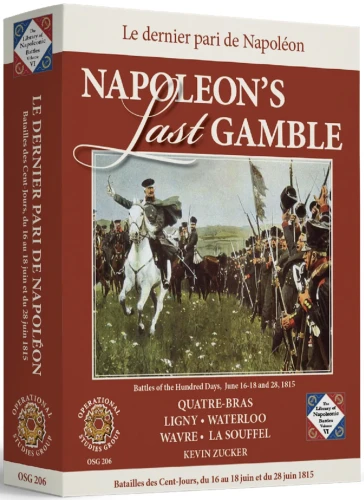
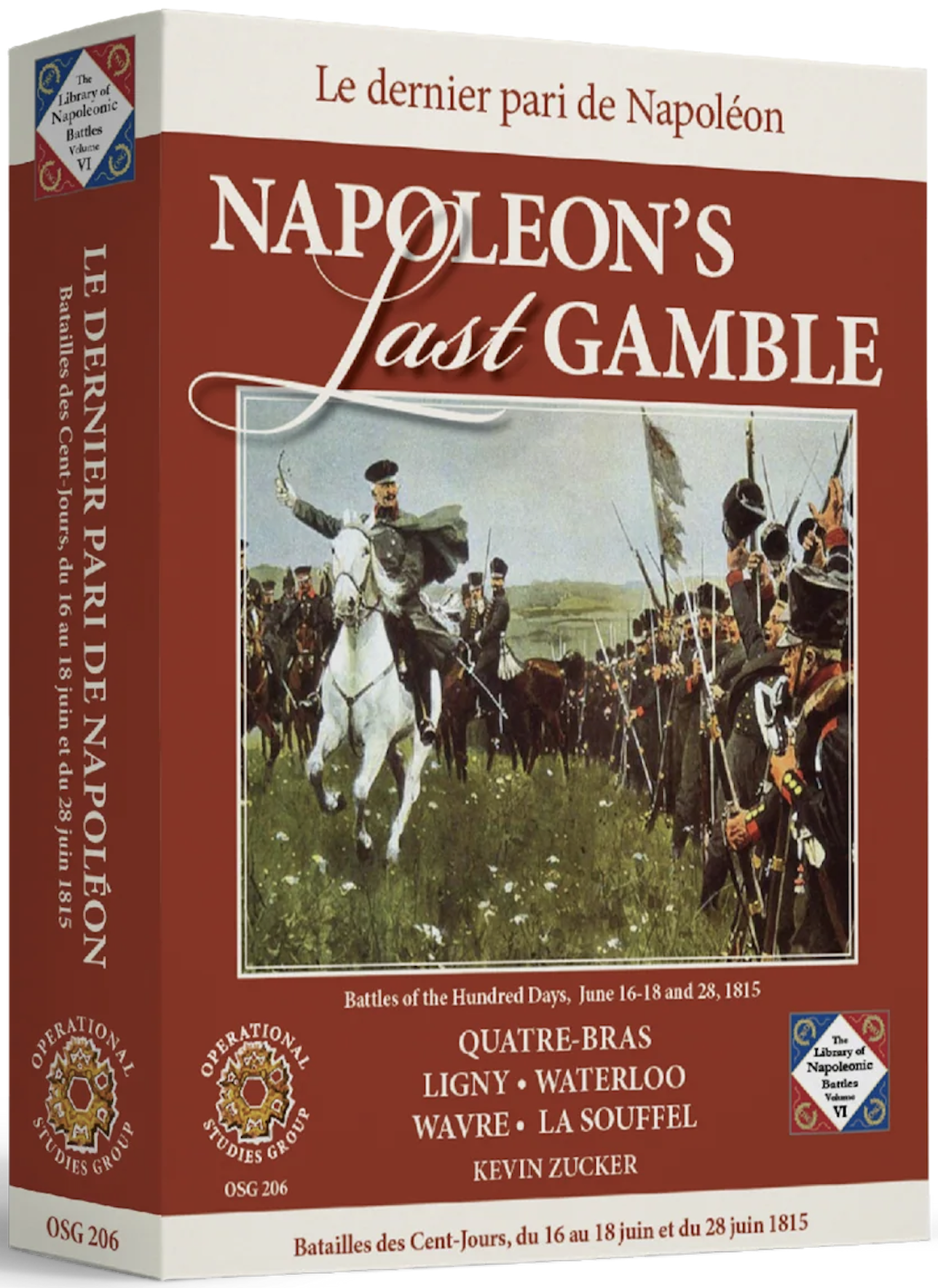
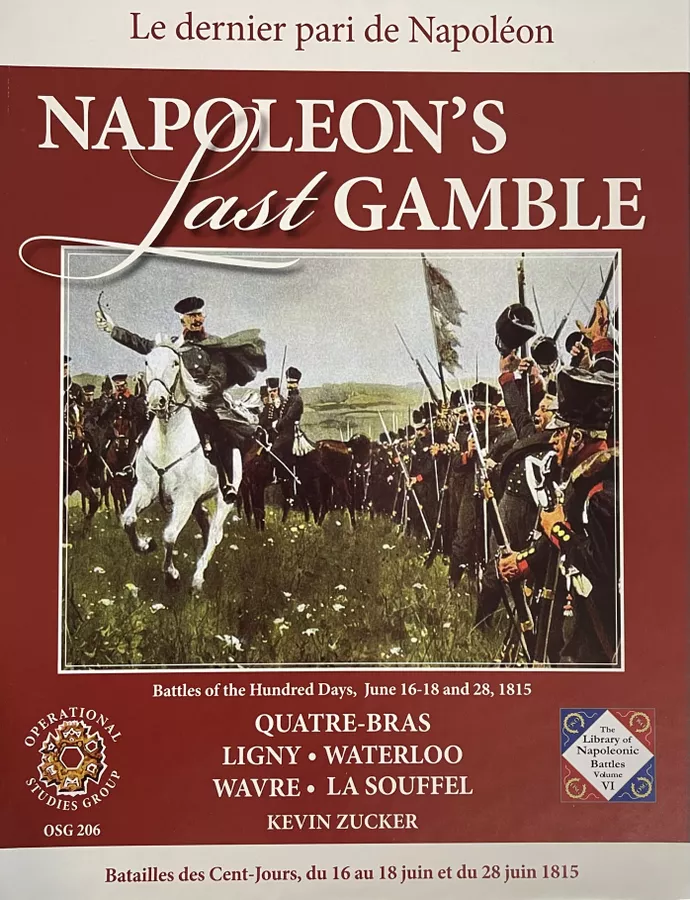
Napoleon’s Last Gamble contains five battles from the Waterloo Campaign, which Napoleon began by seizing the central position between the Prussian and British Armies. On June 15th the Grande Armée was unleashed across the Sambre River. Allied screening forces sent out the warning to headquarters. The Allies executed a forward concentration behind the cover of their screens. As the 16th dawned, troops of both sides still converged on the battlefields.
Napoleon's Last Gamble is one of the games from OSG's Series: The Library of Napoleonic Battles (OSG) series. Details on the series are below, as all the games share a common rules set and game system.
COMPONENTS
- Two 22x34" maps
- One 17x22" map
- 560 die-cut counter units
- 100 playing cards
- two rulebooks
- 15 Player aid cards
- covered in a box
BATTLES SIMULATED
Quatre-Bras, Ney at the Crossroads, 16 June
The French attacked on two fronts simultaneously. The tenacious defense of Quatre Bras by the Anglo-Allied troops saved the Prussians from receiving the full weight of the Armée du Nord.
Ligny, The Last Victory, 16 June
Finally unleashed, the Guard pushed the Prussians back from the Ligny brook. Blücher himself was wounded and separated from headquarters. But Napoleon’s hoped-for knock-out blow remained undelivered.
Wavre, Grouchy’s Blunder, 18 June
Napoleon separated the two wings of his army, ordering Marshal Grouchy on the track of the Prussians while he pursued Wellington. Grouchy’s prescribed route was wide of the mark, and took him to the outer flank, allowing the Prussians to interpose themselves between the two French wings—Blücher achieved a strategic reversal of the opening.
Waterloo, A Near Run Thing, 18 June
While Grouchy frittered away time engaging the Prussian rear-guard at Wavre, Ney conducted the mid-phase of the battle like a rear-guard action in the Peninsular Campaign, failing to provide infantry support for his spectacular cavalry charges. Wellington fought a successful defensive battle, managing to cling to his ridge until the arrival of three Prussian corps. The broken French army retreated toward Charleroi; Grouchy’s intact wing moved south-east toward Namur.
La Souffel, Rapp’s Last Stand, 28 June
Three days after Waterloo, Rapp woke up and began a slow withdrawal from the Rhine, pursued by the vanguard of Schwarzenberg's Army. On June 26 the heavily-outnumbered Rapp skirmished with the Austrian III Corps. Two days later he made a stand along the Souffel River, and the Austrians attacked.
DESCRIPTION
Series: The Library of Napoleonic Battles (OSG) - formerly known as the Napoleon's Last Battles (NLB) Series:
- 480 meters per hex,
- 1 hour per turn,
- 400-800 men per strength point.
Each Approach to Battle game lasts about 22 turns. The Full campaign links the individual battles.
Wyświetlane są wszystkie opinie (pozytywne i negatywne). Nie weryfikujemy, czy pochodzą one od klientów, którzy kupili dany produkt.
Marcin
"Napoleon’s Last Gamble: Battles of the Hundred Days" od Operational Studies Group to bardzo udana gra planszowa dla miłośników historii napoleońskiej i klasycznych gier wojennych. Tytuł świetnie oddaje napięcie ostatniej kampanii Napoleona, prowadzącej do decydujących starć Stu Dni. Gra oferuje ciekawą równowagę między realizmem historycznym a grywalnością, dzięki czemu każda decyzja ma znaczenie: marsze, koncentracja sił, opóźnienia i moment ataku potrafią przesądzić o wyniku rozgrywki. Na szczególną pochwałę zasługuje klimat epoki oraz sposób, w jaki gra zmusza graczy do myślenia w kategoriach operacyjnych, a nie tylko taktycznych. To nie jest prosta symulacja bitwy, lecz pełniejszy obraz kampanii, w której liczy się tempo, ryzyko i umiejętne wykorzystanie ograniczonych możliwości dowodzenia. Dużym atutem gry są bardzo ładne mapy, które pełnią nie tylko funkcję plansz, ale także budują klimat całej rozgrywki. Są czytelne, estetyczne i dobrze oddają charakter pola działań podczas kampanii Stu Dni. Widać w nich dbałość o szczegóły topograficzne, układ dróg, miejscowości i terenów, które miały znaczenie operacyjne. Dzięki temu gracze mają poczucie obcowania nie tylko z abstrakcyjną planszą, lecz z historyczną przestrzenią, w której decyzje marszowe i pozycjonowanie wojsk naprawdę nabierają znaczenia. Mapy są także przyjemne wizualnie: mają klasyczny, elegancki styl typowy dla solidnych gier wojennych, a jednocześnie pozostają praktyczne podczas rozgrywki. To ważne, bo w grach operacyjnych estetyka nie może przeszkadzać w czytelności. W przypadku "Napoleon’s Last Gamble" plansze dobrze łączą oba elementy — są atrakcyjne dla oka i funkcjonalne przy stole. Dla fanów Napoleona, Waterloo i historycznych gier wojennych jest to pozycja zdecydowanie warta uwagi. Napoleon’s Last Gamble daje dużo satysfakcji, dobrze oddaje dramatyzm kampanii 1815 roku i pokazuje, dlaczego ostatnia próba Napoleona wciąż fascynuje graczy oraz historyków.