
Orange Swan
 Podstawowe informacje
| Liczba graczy | 1-4 |
| Zalecany wiek | od 14 lat |
| Czas zabawy | powyżej 180 minut |
| Projektant | Emanuele Santandrea |
| Wydanie | angielskie |
| Instrukcja | angielska |
| Złożoność | dla wymagających graczy |
 niedostępny
 dodaj do przechowalni
Opis
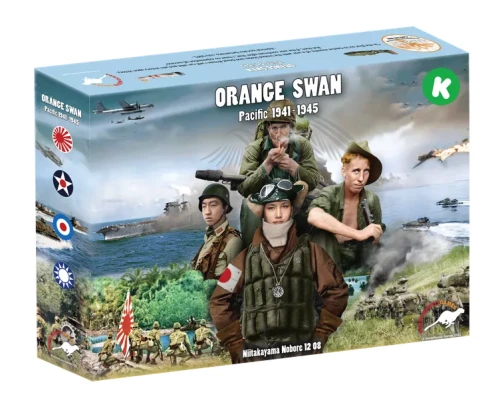
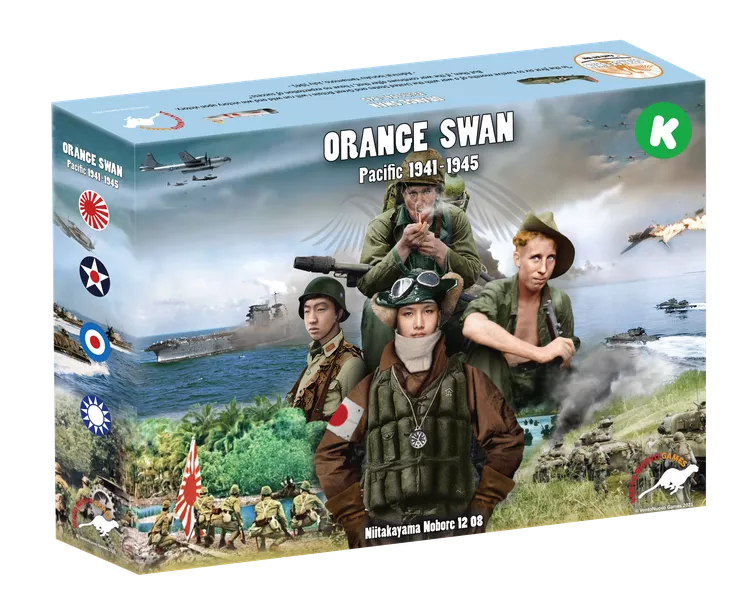
ORANGE SWAN is a historical game that covers WWII in the Pacific from 1941 to 1945. Its name reflects that of its older sibling Black Swan, a game that covers WWII’s European Theatre, but also that of the United States’ plan for fighting Japan, developed long before Pearl Harbor, called War Plan Orange.
Orange Swan uses many of the same game mechanics as Black Swan but with greater focus on the innovative, and mechanically simple, naval systems that were universally praised. One revision that entirely changes the feel of the game is the addition of the Seaborne Blitz phase.
Similar to Black Swan’s land based Blitz double turns that made the Eastern Front so dynamic, Orange Swan translates that idea to a double naval turn. The results are highly satisfying from both a gameplay and historical perspective. Similar to other block games, Fog of War is a core element in ORANGE SWAN, as a player cannot know the identity or the strength of an enemy unit until it is revealed in combat.
While Orange Swan’s campaigns and scenarios feature historical starting points, the outcome is completely unpredictable and, despite the historical result, the Axis Side (Japan) can defeat the Allied Side (the United States, the Commonwealth, and China).
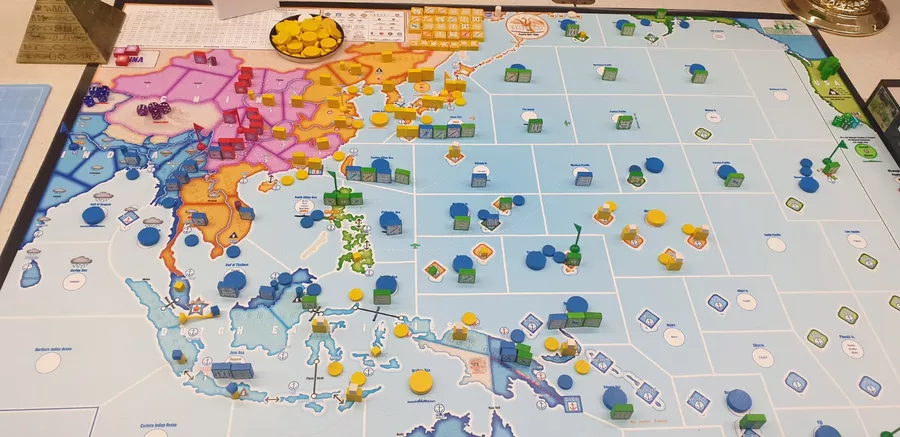
The Allied Side can cooperate, so they can stack together, or trace supply accross either a Sea Zone or a Land Area Controlled by an Allied Nation. (Note: Chinese Communists stack only with themselves). Japan, the United States (US), the Commonwealth (CW), and China are Major Nations. The Philippines and Dutch East Indies (DEI) are Minor Nations controlled by the US and CW respectively.
No Side can enter Land Areas belonging to the Soviet Union or any of the Absolute Neutrals, identified with a white border: Nepal and Butan.
Each Major Nation has its own units (in a specific color), Force Pool, Economic and Strategic Power.
The Force Pool of a Nation is made up of all units of that Nation that are not deployed on the mapboard and are available to be built (that is, purchased during the Production Phase). Note that some units have a colored circled number (2, 3, or 4) in one corner, indicating the year when the unit is added to the respective Force Pool. Thus, in 1943 it is not possible to build a Unit marked with a circled “4", as it will be added to the proper Nation's Force Pool in Winter 1944. Elite Units are designated with a darker color background.
Nations of the same Side maintain their own Supply Source (their National Capital) but they can trace Supply using any of their Side’s Naval Units, Controlled Land Areas, or Controlled Sea Zones. They can freely enter any Land Area of, and be transported by, the Naval Units of their Side. They can stack, move, and attack together, but each Nation keeps its own Force Pool, Economic and Strategic Power.
China has two kinds of forces: Nationalists and Communists. Both Chinese Nationalists and Chinese Communists are always supplied and therefore do not need to trace any supply.
Chinese Communist Units can only stack with other Chinese Communists. They can, obviously, attack any Axis Side Units. Chinese Nationalists can stack (and move/attack) freely with units of the Allied Side.
All Chinese units are restricted to Continental Asia and Hainan and can never be Sea Transported.
National Capitals: Nations have the following Capitals, which also act as Supply Sources:
1. Japan: Tokyo
2. US: San Diego
3. CW: New Delhi and Sidney
4. Philippines: Manila
5. Dutch East Indies: Batavia
Nation’s have their own blocks of the following color:
1. Japan: orange
2. US: green
3. CW: blue
4. China: purple
5. Philippines: light green
6. Dutch East Indies (DEI): light blue
Minor Nations do not have their own Economic or Strategic Power, nor a dedicated Force Pool. They are controlled by the Major Power they are allied to, which treats them as if they were CW (for the DEI) or US (for the Philippines) units for all game effects. When destroyed, Minor Nations units are eliminated from the game, so they will never go into any Force Pool.
| Warto zobaczyć: | |
|
|
Wyświetlane są wszystkie opinie (pozytywne i negatywne). Nie weryfikujemy, czy pochodzą one od klientów, którzy kupili dany produkt.